



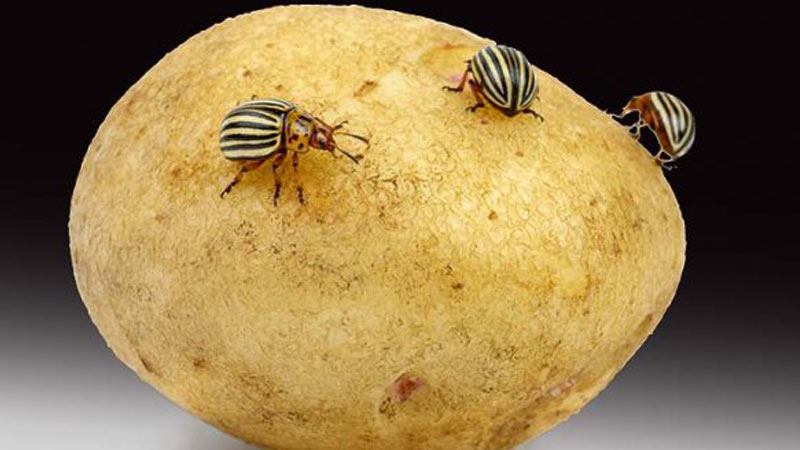
Potato is one of the most important crops in the world, especially in Iran, which plays an important role in food security. Despite the importance of this crop, various pests can severely reduce its yield and quality. Accurate knowledge of pests, their life cycles, and scientific control methods play a fundamental role in the successful management of potato fields. In this article, we will introduce the most important potato pests and their control methods.
1. Colorado Potato Beetle
Introduction and Importance
The Colorado potato beetle is one of the most destructive potato pests. By feeding heavily on plant leaves, this insect can disrupt photosynthesis and consequently reduce growth and yield. Both larvae and adult insects are damaging.
Life cycle
This beetle spends the winter as an adult insect in the soil and becomes active when the weather warms. Females lay their eggs in clusters on the back of the leaves.
Control strategies
Agronomic practices: crop rotation, deep autumn plowing, and complete removal of plant debris.
Biological: Use of Bacillus thuringiensis bacteria to control larvae.
Chemical: Use of selective insecticides when young larvae emerge, along with consideration of pest resistance and rotation of active ingredients.
2. Wireworms
Introduction and importance
Wireworms are the larvae of a species of click beetle (Elateridae) that live in the soil and feed on potato roots and tubers. This pest causes holes and dryness in the tubers, which reduces the market value of the product.
Life cycle
Their life cycle is long and the larvae may remain in the soil for 2 to 5 years.
Control methods
Crop rotation with non-host plants such as legumes.
Proper irrigation and soil moisture management (as wireworms prefer high humidity).
Baiting with pieces of grain or carrots to establish populations and reduce egg laying.
Limited use of soil-borne pesticides in severe infestation conditions.
3. Aphids
Introduction and importance
In addition to direct damage by sucking plant sap, aphids are known to be vectors of important potato viruses such as leaf curl virus (PVY). This makes them one of the key pests of seed potato fields.
Characteristics
Aphids reproduce very quickly and their populations are explosive in hot and dry conditions.
Control strategies
Planting virus-resistant varieties
Biological control: releasing ladybugs, wasps, and parasitoid wasps
Use mineral oils to reduce virus transmission
Use insecticides in a targeted manner and when aphid populations exceed economic thresholds
4. Potato Tuber Moth
Introduction
Potato Tuber Moth causes damage both in the field and during storage. Larvae feed on leaves, stems, and especially tubers, creating tunnels. These tunnels allow fungi to enter and cause tuber rot.
Suitable conditions for activity
Tropical and subtropical regions are most affected. Poor ventilation and improper storage also exacerbate the damage.
Pest Control
Covering tubers with soil in the field to prevent moth eggs
Using pheromone traps to catch and monitor the population
Principled storage: low temperature, proper ventilation, and protection from light
Fogging or spraying appropriate insecticides in the field and warehouse
5. Potato Cyst Nematode
Importance
Cyst nematode is a quarantine and very dangerous potato pest. By feeding on the roots, this pest causes growth to stop, tubers to shrink, and yields to decrease significantly.
Characteristics
Nematode cysts can survive in the soil for more than 10 years, making it very difficult to control.
Control strategies
Planting resistant varieties
Long-term crop rotation (3 to 5 years)
No transport of contaminated soil by machinery
Nematocidal pesticides in heavily contaminated fields
Summary
Potato, as one of the strategic crops, is affected by several pests, each of which can reduce the quality and quantity of the crop. Identifying pests, implementing crop rotation, using biological control, employing correct storage methods, and using pesticides systematically, constitute a set of integrated pest management (IPM) strategies that reduce damage and increase production sustainability.